

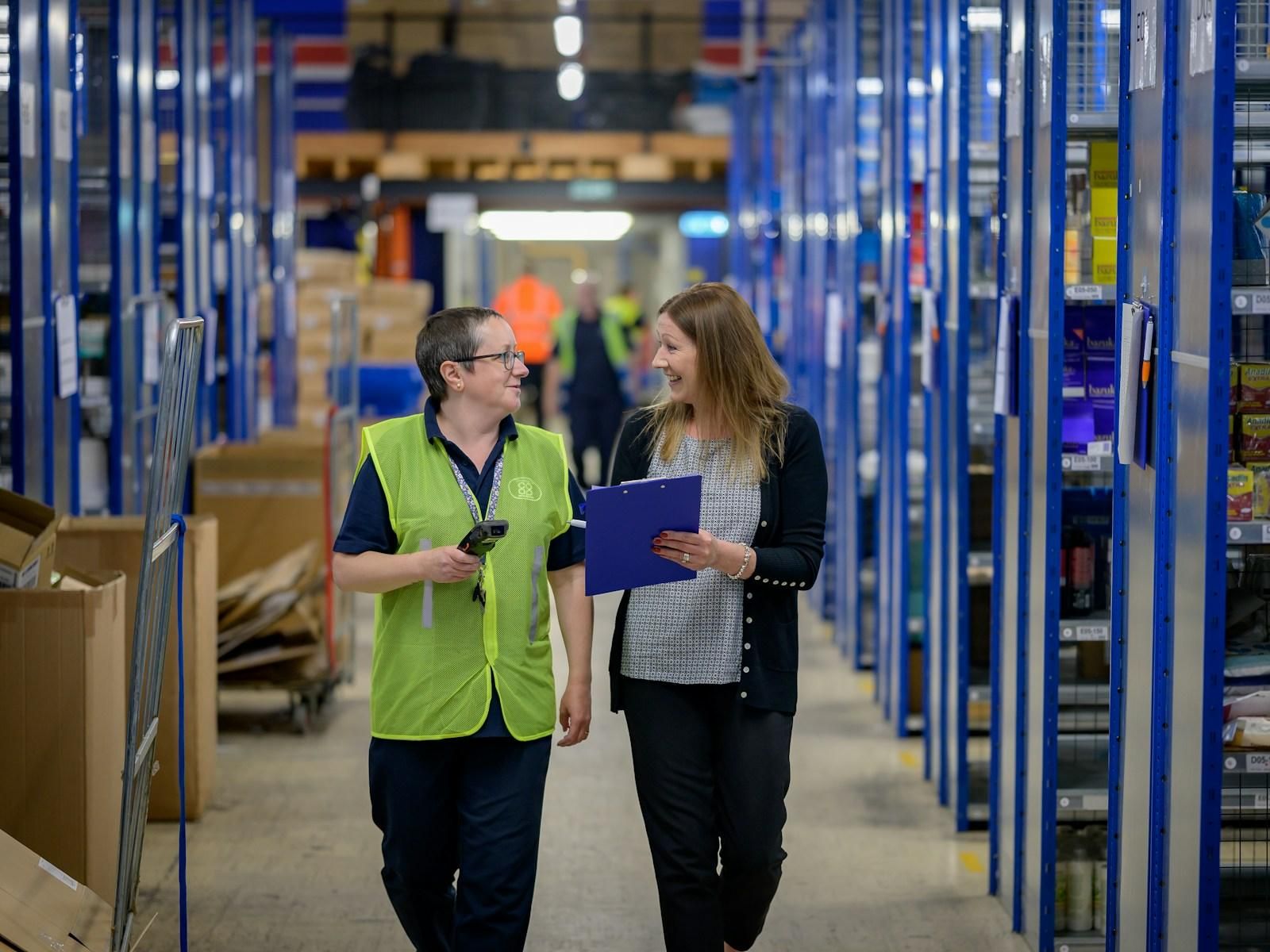

What is the working aisle width?
The working aisle width (often written as Ast) is the minimum width between two rows of racking, or between the loads stored in them, in which a forklift can safely turn, put away and retrieve a pallet. Driving through the aisle is not enough – the truck must turn through 90° with a pallet on its forks.
How wide an aisle does each type of truck need?
The values in the table are a guide for a standard EUR pallet. The actual width depends on the model, fork length, pallet size and the truck manufacturer.
| Truck type | Typical working aisle width |
|---|---|
| Counterbalance forklift | about 3.2–4.0 m |
| Reach truck | about 2.6–3.1 m |
| Very narrow aisle (VNA) truck | about 1.6–2.0 m |
| Hand or powered pallet truck | about 1.8–2.4 m |
What determines the aisle width you need?
Truck type and model
A counterbalance forklift turns its whole body and therefore needs the most space. A reach truck retracts its mast and load, so it works in a narrower aisle. Very narrow aisle trucks do not turn in the aisle; they put pallets away sideways and usually run on rail or wire guidance in the floor.
Pallet size and orientation
The same truck needs a different aisle width depending on whether it picks the pallet by its long or short side. Between a 1200×800 EUR pallet and a 1200×1000 industrial pallet the difference can be several tens of centimetres.
Safety clearances
On top of the working width you need clearances between the load and the rack structure and between the load and the truck. General rules for clearances and tolerances are set out in EN 15620; the specific values are fixed in the design.
Traffic in the aisle
If people also walk in the aisle, or trucks need to pass each other, the aisle must be wider than the minimum working width. The same applies to main routes and loading zones.
Where do you find the exact figure?
Forklift manufacturers state the working aisle width for given pallet sizes in their technical data sheets. That is the starting value for the design. If you are planning to buy a new truck, it is best to decide on aisle width and truck model together.
Narrower aisles or more pallet positions?
Every centimetre saved in the aisle means more room for racking. Yet an aisle that is too narrow slows operations and increases the risk of rack impacts. A good design balances capacity, speed and safety.
What about cross aisles and escape routes?
Long, unbroken runs of racking lengthen travel for both trucks and people. Cross aisles shorten the routes between zones and improve access. Planning must also respect escape routes, exits and firefighting equipment in line with local regulations and the building's requirements. It is best to confirm these requirements before the layout is finally approved.
How does EL-FAM plan aisles?
When designing a warehouse we start from your forklift and pallet data, and only then draw the layout of runs and aisles. We then manufacture the racking in our own plant and install it to that design. Send us your floor dimensions, truck type and pallet size and we will propose a layout.
Frequently asked questions
Can a counterbalance forklift work in a 2.5 m aisle?
As a rule, no, because a counterbalance truck turns its whole body with the pallet and needs a much wider aisle. Narrower aisles call for a reach truck or a very narrow aisle truck.
Is aisle width measured between racks or between pallets?
It is measured between the loads, i.e. the parts that project furthest into the aisle, because pallets often overhang the beams. That is why you need the exact pallet dimensions.
What is a very narrow aisle (VNA)?
It is an aisle in which the truck does not turn but puts pallets away sideways, usually with rail or wire guidance in the floor. It gives more pallet positions but needs special trucks and a very flat floor.
Who decides the final aisle width?
The starting value comes from the forklift manufacturer, and the final width, including safety clearances, is set in the warehouse design.
