

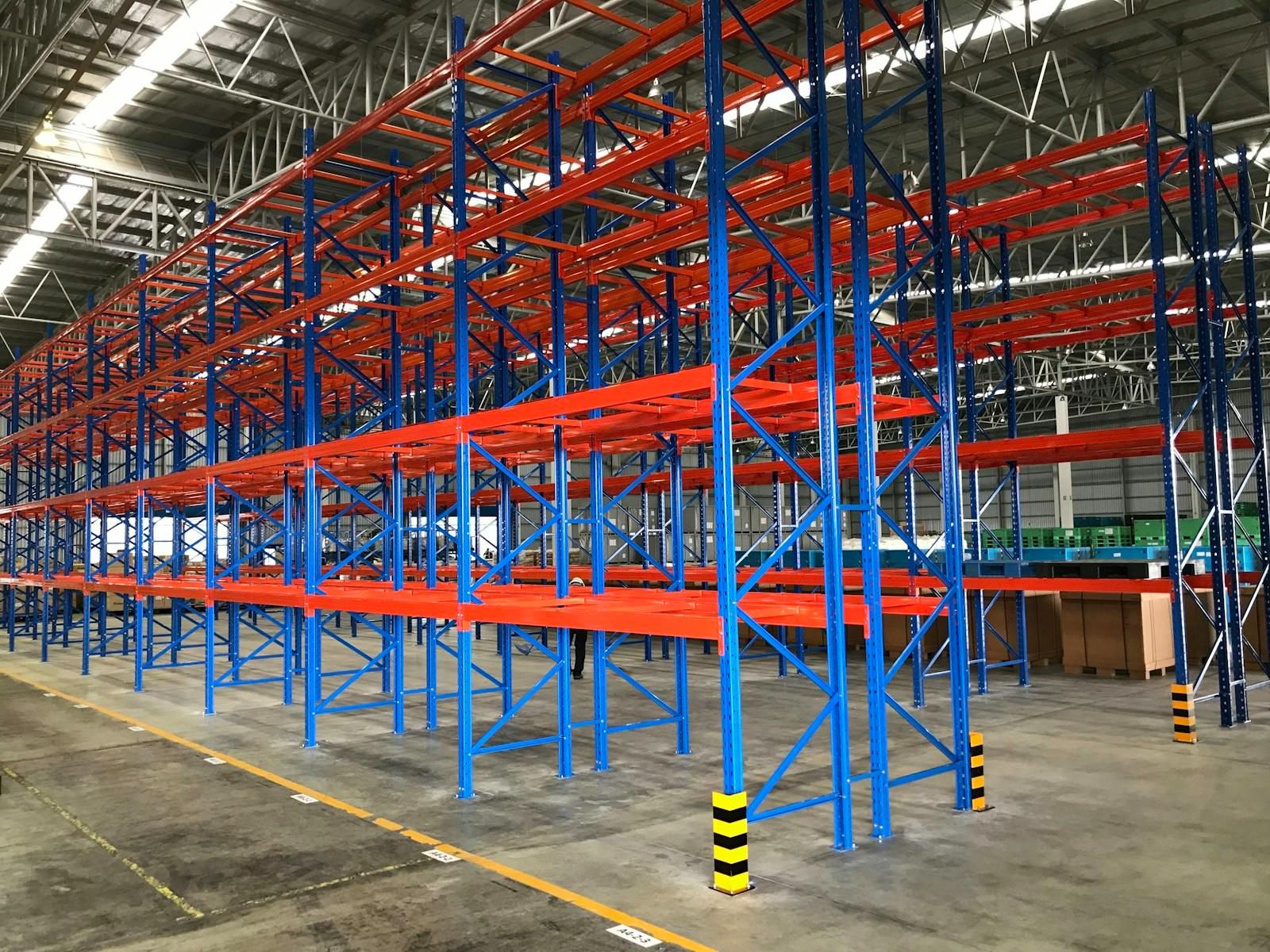
Pallet racking
For palletised goods handled by forklift. Direct access to every pallet and full use of the building height.
Benefits
More pallet positions
Uses the full building height instead of floor storage.
Direct access
Every pallet reachable without moving other goods.
Easy to extend
Add bays and levels as your business grows.

Pallet racking is the backbone of most warehouses: every pallet has its own location and can be reached directly, without moving other goods. A well-planned system multiplies the number of pallet positions on the same floor area by using the height that floor storage leaves empty.
Frame height, beam length, number of levels and load capacity are set by your goods, aisle width and the forklift you use. Because we manufacture the racking ourselves, we are not limited to catalogue sizes — the layout follows your building columns, doors and services.
How we plan it
We start from the unit load (pallet size and weight), the building height and your handling equipment. From there we calculate capacity per level and per bay, define aisle widths and prepare the layout. Every system comes with load notices and guidance for safe operation.
Variants and options
- Single and double-entry runs
- Heights and capacities to project
- Decking: wire mesh, steel or timber
- Upright and end-of-aisle protection
- Pallet stops and anti-collapse mesh
- Load notices
Typical applications
- Distribution centres
- Production halls
- Wholesale and retail
- Logistics providers
Insights on this topic
All insightsHow is pallet racking load capacity determined?
Capacity is calculated separately for each level (pair of beams) and for the whole bay (frames). It depends on beam profile and length, frame height and level spacing, and is shown on the load notice.
What affects the price of pallet racking?
The price of pallet racking is driven mainly by frame height, load per level, number of pallet positions and beam length, followed by accessories, installation, transport and documentation.
What information do you need for a racking quote?
A racking quote needs the floor dimensions and clear height, the unit load size and weight, the number of positions required, the forklift type, and a drawing or photos of the building.
Frequently asked questions
What information should I send for a quote?
Basic details are enough: room dimensions (length, width, clear height), type and weight of goods, load unit (e.g. Euro pallet), handling method and site location. We complete the rest together.
Can I attach a drawing or photos of the hall?
Yes. In the quote form you can attach up to 5 files (PDF, JPG, PNG, DWG, DXF).
How can I estimate the number of pallet positions?
Use our free pallet position calculator. You can send the result straight away as a quote request.
How will I know my enquiry has arrived?
After sending, you receive an enquiry number and an email confirmation with a summary of the data you submitted.
Send us your floor dimensions. We will propose a solution.
The basics are enough: floor dimensions and clear height, type of goods and approximate weight. A drawing or photo helps even more.