

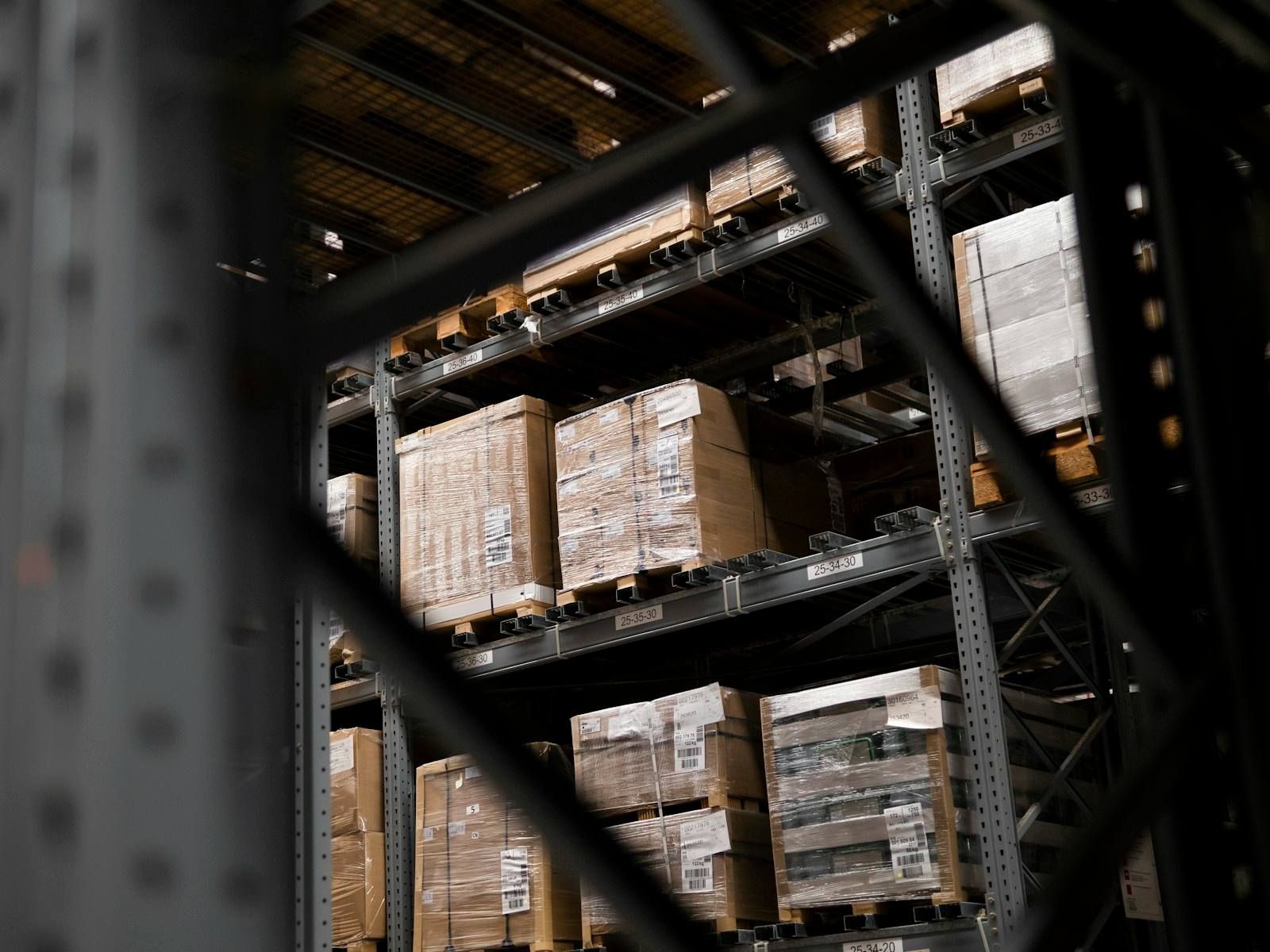

What is a radio shuttle system?
A radio shuttle (pallet shuttle) is a compact pallet storage system. Pallets do not stand side by side along an aisle but one behind another in deep racking lanes, on steel rails. Inside the lane a shuttle does the work – a battery-powered vehicle that runs beneath the pallets and carries them through the lane. The forklift no longer enters the racking; it only delivers and collects pallets at the lane entrance.
How does it work, step by step?
- The forklift places a pallet at the lane entrance.
- The driver starts the shuttle with a remote control. The shuttle moves under the pallet, lifts it off the rails and carries it to the first free position deep in the lane.
- The shuttle sets the pallet down and returns to the entrance for the next one, so the lane fills from the back towards the front.
- For retrieval the shuttle brings pallets to the entrance one by one, where the forklift picks them up.
- When a lane is finished, the forklift moves the shuttle to the next lane or to another level.
In larger installations, commands for the shuttle can also come directly from the warehouse management system (WMS).
FIFO or LIFO – how do goods flow?
A lane can work in two ways. With LIFO, pallets go in and out on the same side of the racking – the last pallet in is the first out. That is fine for goods without a shelf life or with a long one. With FIFO, pallets are loaded on one side and retrieved on the other, so the first pallet in is the first out – important for food and anything with a best-before date. The choice is made at the design stage, because it shapes the racking and aisle layout.
When does a radio shuttle pay off?
- Many pallets of the same item – e.g. beverages, food products, packaging, raw materials and finished goods in batches.
- Expensive space – especially cold stores and freezers, where every cubic metre costs money and driving a forklift inside the racking is slow and risky.
- More capacity in the same building – deep lanes need less space for aisles than conventional pallet racking.
- Less damage – the forklift does not drive through the racking, so impacts on uprights and damage to goods are rarer.
When is it not the best choice?
If you hold many different items with only a few pallets each and need direct access to every pallet, conventional pallet racking is usually the better solution. A radio shuttle also needs uniform pallets in good condition and a level floor, because the shuttle travels on rails through the full depth of the lane.
What do we need for a quote?
Floor dimensions and clear height of the building, pallet type and size, pallet weight, number of items and pallets per item, storage temperature (ambient, chilled or frozen) and the required flow principle (FIFO or LIFO). From this we design the lane layout and size the racking structure, which we manufacture in our own plant.
Frequently asked questions
Who operates the shuttle?
The forklift driver, with a remote control. The forklift moves the shuttle from lane to lane. In larger systems, commands can come from a WMS.
Can a radio shuttle work in a freezer?
Yes, there are shuttle versions for chilled and frozen stores. We then adapt the racking structure to the building conditions.
Does the shuttle work FIFO or LIFO?
Both are possible. LIFO when loading and retrieving from the same side, FIFO when loading on one side and retrieving on the other.
How much load does the shuttle carry?
The shuttle carries pallets up to 1,500 kg, handles pallets of different sizes and works down to −30 °C.
Which is better: radio shuttle or conventional pallet racking?
For many pallets of few items – radio shuttle. For many different items and direct access to every pallet – conventional pallet racking.


